
Technical Photography
Our in-house services include calibrated reproduction, infrared, ultraviolet fluorescence, and other advanced surface imaging. Images can be produced for print, publication, online use and archival records. Artwork can be photographed at our studio or on site at your museum, gallery, or home.
Ultraviolet Fluorescence Photography
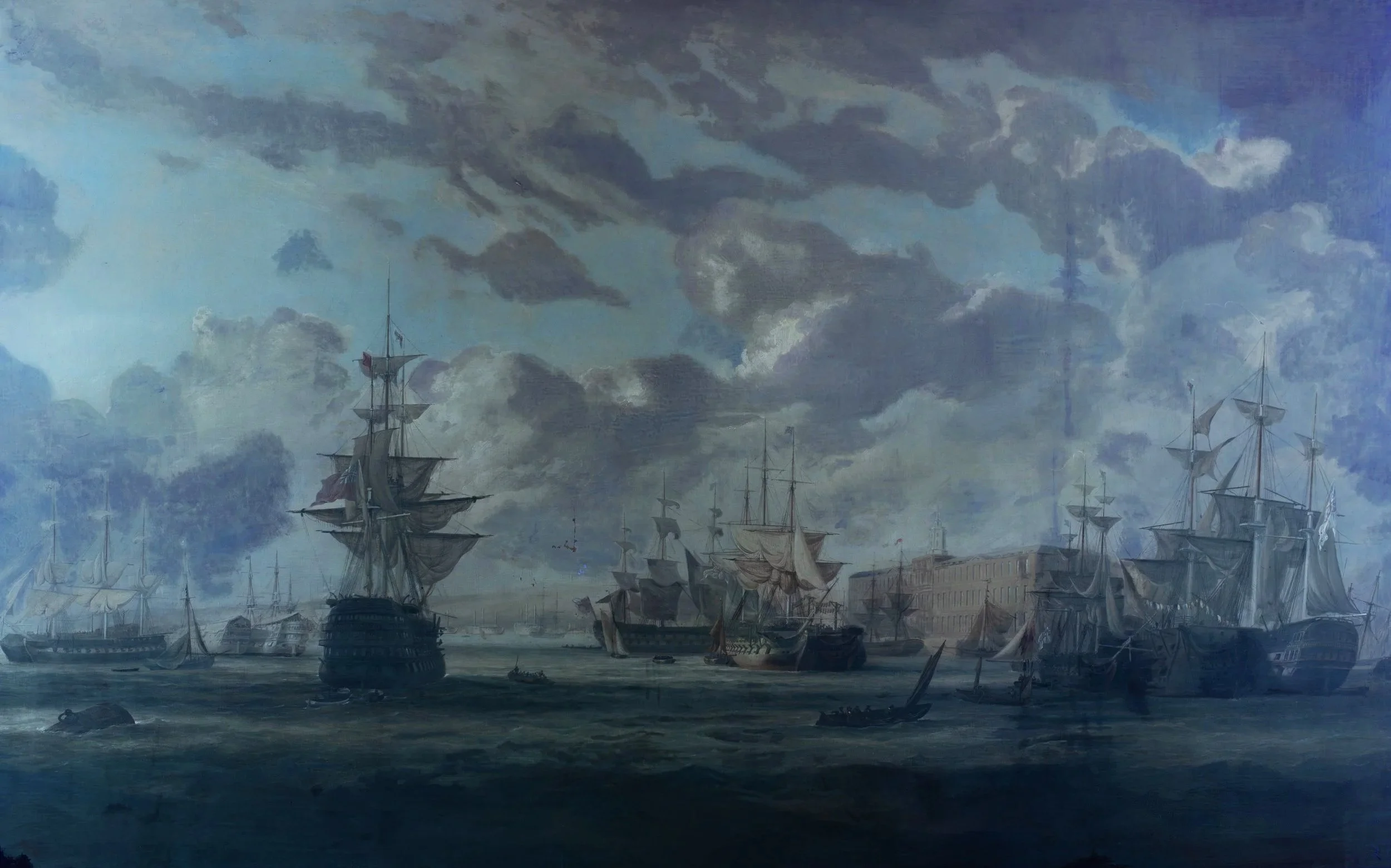
When exposed to ultraviolet light, the painting exhibits a light blue fluorescence, indicating the presence of a natural resin varnish. Darker fluorescence suggests overpaint, while an accretion on the right-hand side appears as a dark blue area. Ultraviolet photography is an important tool in conservation, aiding the identification of surface coatings and later interventions, and helping to guide treatment decisions, including varnish removal.
National Museum of the Royal Navy
Title:Portsmouth Harbour
Artist: John Christian Schetky
Infrared Gigapixel Photography
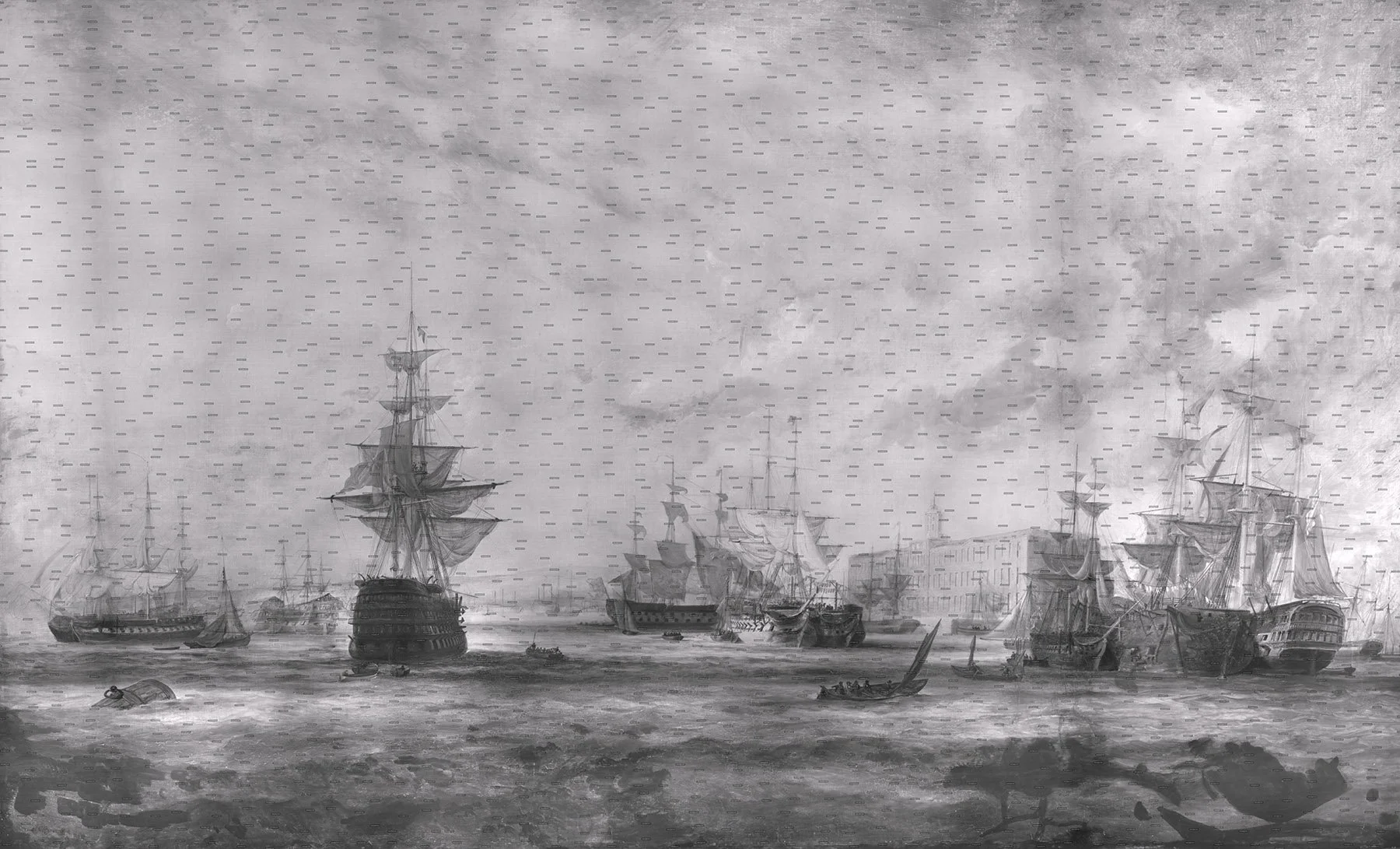
This high-resolution infrared gigapixel image, created from a stitch of 200 photographs, allows close-up evaluation of the painting in exceptional detail. In this image, infrared reflectance reveals areas of overpaint and other material changes across the surface. It also indicates alterations made by the artist, with evidence of underdrawing visible beneath the painted layers. This method is particularly valuable in conservation, as it helps to improve understanding of the artist’s process, the structure of the work, and later interventions.
-
Colour accuracy
Each image is profiled using controlled lighting with a high CRI (colour rendition index), custom white balance and reference colour targets. Files are calibrated to recognised standards for a faithful match from capture to final output.Resolution and detail
Single frame or stitched mosaic capture can produce ultra high resolution files that exceeds 200 megapixels.Archival
The files meet professional archival standards and are suitable for cataloguing, comparison over time, conservation records, insurance and publication. This service is designed for artists, galleries, estates and collections that need true to life reproduction and a permanent visual record. -
An Infrared Photograph capture at a wavelength between 850 nm and 1,070 nm.
What it shows
It reveals underdrawing, compositional changes and hidden marks beneath the paint layer. It highlights carbon based materials such as graphite or charcoal and helps conservators and researchers.How it is used
Useful for studying the artist’s process, confirming later additions or overpaint and supporting attribution and comparative study.Notes on Infrared Reflectography (IRR)
Standard Infrared (IR) does not always penetrate as deeply as IRR at about 1,700 nm and some varnishes or pigments can reduce clarity. IRR often gives greater contrast in underdrawing and is preferred for full mapping. That said, near IR can sometimes reveal more than IRR, especially with some blue based pigments such as cobalt blue, cobalt violet and smalt, which tend to be more transparent in near IR and darker in IRR. -
UV light causes certain materials on the surface to fluoresce. We work in a darkened room with filtered UV light sources and camera filtration to record the fluorescence consistently. Images are supplied with a matched visible light reference for comparison.
What it shows
UVF can reveal varnish layers and their condition, overpaint and retouching, areas of restoration and surface coatings or residues. It is widely used to separate original paint from later additions and to assess surface condition. -
Low angle side lighting exaggerates surface texture. We place a single light at a shallow angle to the surface and can record paired images to show both directions of rake where helpful.
What it shows
RAK reveals brushwork and impasto, cracking, lifting, cupping and loss. It also shows panel warp, canvas distortion, dents, deformations, tool marks and surface abrasion. It is important for condition reports and treatment planning because it records the physical state of the surface at a specific moment in time. -
The surface is photographed many times under controlled light from different directions. The photographs are combined in an interactive file that can be digitally relit and explored. As part of an HRTI session, specialist viewing techniques can also be used to reveal detail that is difficult to see with the naked eye.
What it shows
Tool marks and brushwork in fine detail, craquelure patterns, deformation, lifting and local damage. It is valuable for monitoring condition over time and for evidence based documentation.
Portable Imaging Service
If the artwork is of high value or fragile in nature, it can be photographed on site using a portable studio setup. This avoids transport risks and keeps handling to a minimum. The system is compact, free-standing and suitable for most studios, galleries and private homes.
Pre-Visit Checklist
We will send a brief checklist before we visit to confirm the essentials and answer any questions. It covers space requirements and any light control needed, such as covering windows for Ultraviolet photography. We will confirm access and timing in advance and take care of the set-up. We will also provide our terms and conditions ahead of time, so the process is straightforward.